There are measurements that soothe the soul immensely. You click the big colorful button in the browser, the needle shoots up, and at the end there's 940 Mbps downstream and a solid 50 Mbps upstream. A figure straight out of the marketing brochure. The hotline agent spots it in their system, leans back, and declares the matter closed: "Line is up, metrics are green, have a pleasant day."
The problem with this: A TCP-based speedtest does not measure line health. It merely measures how much water can be forced through a ruptured pipe when running the pump at full blast for ten seconds.
So if you want to understand why VoIP calls still sound like they're coming from a tin can, SSH sessions freeze, and real-time connections intermittently collapse, you have to dig deeper — straight down to the physical layer of the FRITZ!Box.
There, October on our Vodafone cable connection looked less like gigabit bliss and more like a debris field: 85,736,633 uncorrectable codewords, 97% of all measurements across an entire month in a Critical state, and an upstream screaming at the absolute power limit against a deaf receiver.
The trigger was an infrastructure classic: An excavator strike.
The Excavator in the Front Yard
It feels like Telekom has been digging here for years.
In any case, fiber rollout has been dragging through the town like thick dough for months. Perpetually torn-up sidewalks, construction barriers, trenches left open for days, and subcontractors drilling and milling through the local sand with mini-excavators and horizontal directional drills. You get used to the noise. What people forget: There's already stuff buried down there.
And if you poke deep enough, you eventually hit Vodafone's old coaxial cable.
A sharp jerk, the excavator won, and suddenly the entire street went pitch black for about 28 hours. No downstream, no upstream, dead silence. A textbook route outage, the kind that simply happens in day-to-day civil engineering.
Eventually a Vodafone crew showed up, dropped a temporary splice closure into the trench, shoveled the sand back on top, and the cable modem actually synced up again. Synchronisation established. Vodafone patted itself on the back and internally marked the ticket as a successfully resolved major incident.
On paper, everything was fine again — but in reality, that's where the misery actually began.
The connection suddenly behaved like a temperamental loose contact. Not dead entirely — standard bulk downloads pulled through if given enough time. But the moment latency or continuous data flow came into play, the connection derailed. Crackling in VoIP calls, dropped handshakes, an SSH terminal freezing mid-keystroke for three seconds.
And right here is where the wall of canned responses begins.
Anyone trying to explain a problem to a cable provider that doesn't fit into the binary "Works / Doesn't work" matrix hits a concrete wall. The customer portal chatbot only understands zero or one. Because the modem is online, it simply refuses to open a ticket. If you call the hotline, the rep runs the internal line test, sees green checkmarks, and politely suggests power-cycling the router for ten minutes. Tickets submitted via detour are closed hours later without comment: No error detectable in the network.
Reaching out in writing? Forget it. Customer service email addresses are de facto extinct, executive mailboxes bounce into the void, and contact forms are nested so deeply you end up running in circles.
The system is not engineered to diagnose complex faults on the physical layer. It is engineered to deflect complaints until the customer gives up in exhaustion.
So you stop making phone calls and start taking measurements.
Physics Doesn't Lie: What Happens Inside the Coaxial Cable
When an ISP — in our case Vodafone — insists there is no issue, the only thing that helps is looking at the FRITZ!Box registers. Not through the glossy web UI with rounded numbers, but raw via the TR-064 interface.
For this, I run DOCSight. The tool polls the DOCSIS interface at fixed intervals and writes parameters straight into a time-series database. No guesswork, no feelings. Pure high-frequency telemetry.
What accumulated over the entirety of October — exactly 1,780 data points — was the exact opposite of "everything is fine":
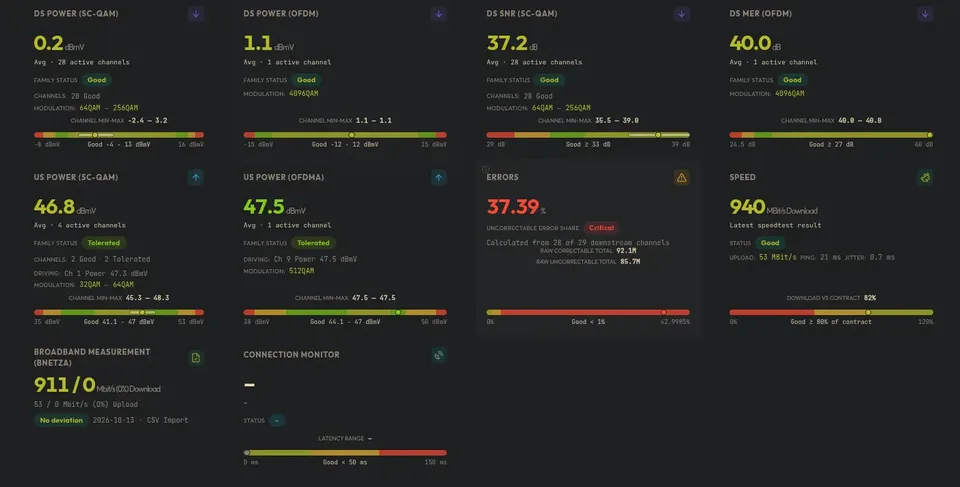
| Parameter | Value | VFKD Target (Good) | Assessment |
|---|---|---|---|
| Overall State | 1,731 of 1,780 checks (97%) | 100% Good | CRITICAL |
| Uncorrectable Codewords | 85,736,633 | near 0 | Massive Packet Loss |
| Channel 2 (130 MHz, DS) | 54,915,262 uncorrectable errors | 0 | Ingress / Filter Issue |
| Channel 33 (OFDM, DS) | 30,702,621 uncorrectable errors | 0 | Errors in DOCSIS 3.1 Block |
| Upstream OFDMA (Ch 9) | up to 50.3 dBmV | 44.1 to 47.0 dBmV | Above Tolerance Limit |
| Downstream Cliff (698 MHz) | Level drop by 5.6 dB | flat frequency response (±2 dB) | Missing Equalization / Diplexer Fault |
Behind this lies tangible RF engineering.
Codewords: Reed-Solomon, LDPC, and the 10-Million Spike
DOCSIS does not send data across the line as raw IP packets. It wraps them in codewords protected by Forward Error Correction (FEC): Reed-Solomon in DOCSIS 3.0, LDPC matrices (Low-Density Parity-Check) within the DOCSIS 3.1 OFDM block.
When a bit flips on the wire, the mathematics absorb it. That is a Correctable Error — entirely normal on shared coax media.
When noise overwhelms the error correction, however, things break:
An Uncorrectable Error. The modem drops the entire frame. It is gone. TCP must painstakingly retransmit segments, while UDP packets carrying voice or DNS queries are simply lost.
The modem counted over 85 million of these uncorrectable errors in October. And they did not occur evenly. On the evening of October 15, there was a 90-minute window in which the counter spiked by over 10 million — synchronized with a measurable 8.3% packet loss to ping targets.
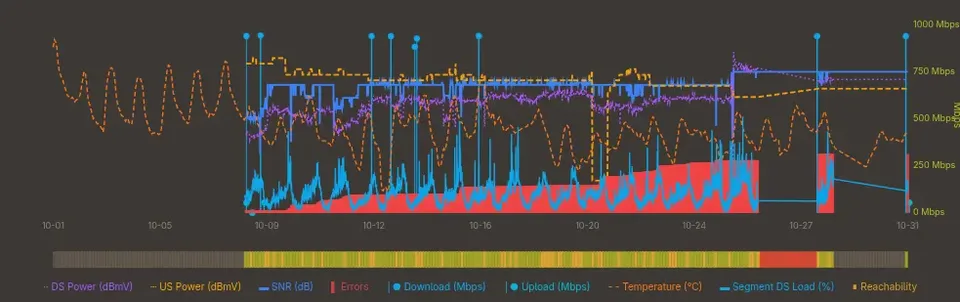
Why does a speedtest the next day still display 940 Mbps? Because during a static download, TCP spins up multiple streams and relentlessly requests dropped chunks until throughput stabilizes. A speedtest measures bandwidth in an idle state, not line integrity.
The 698 MHz Edge: A 5.6 dB Attenuation Cliff
Coaxial cables naturally attenuate higher frequencies more severely than lower ones. To compensate, every house distribution amplifier and street-level line amplifier features an equalizer (tilt or slope). It attenuates the lower frequencies so that, ideally, a largely flat power level arrives across the entire spectrum.
On our connection, the spectrum looked like this: Up to 690 MHz (Channel 17), the power level sat at an unobtrusive +3.3 dBmV with 256QAM. Yet just 8 MHz higher, at 698 MHz (Channel 18), the level abruptly plummeted to -2.3 dBmV.
A drop of 5.6 dB within a single raster step.
The consequence: Every single channel from 698 to 786 MHz failed to sustain 256QAM and remained nailed down at 64QAM. A short patch cable in the apartment does not cause this. Such an abrupt level cliff typically points to a damaged underground splice closure, a defective tap, or a faulty diplex filter along the line.
This purely captures the factual measurement data without leaving room for theoretical debates about CMTS modulation profiles.
Return Path: Transmit Power at the Edge
In the upstream direction, power is not determined by the FRITZ!Box, but commanded by the CMTS at the headend. Through ranging, the headend measures incoming signal strength. If too little arrives — whether due to excessive underground attenuation or ingress noise flooding the return path —, the CMTS instructs the modem to ramp up its transmit power.
According to Vodafone's specification (VFKD), the ideal range for the DOCSIS 3.1 OFDMA channel lies between 44.1 and 47.0 dBmV. From 48.0 dBmV onward, the upper tolerance limit is reached.
Our box transmitted at 47.5 to 48.3 dBmV for nearly the entire month, peaking at 50.3 dBmV. The modem was operating continuously at its physical power threshold. Simultaneously, the CMTS flipped the modulation of DOCSIS 3.0 upstream channels between 64QAM and 32QAM every 15 minutes in a desperate bid to evade the noise floor.
The Leverage: How Section 58 TKG Halts the Hotline Carousel
When a provider decides to simply sit out an issue, German telecommunications law has offered a potent tool since late 2021 that many users are unaware of: Section 58 TKG.
The regulation is refreshingly pragmatic. It obligates the provider to clear disruptions immediately and free of charge. If the provider fails to do so within one calendar day, it must inform the customer on the following day, unprompted, what steps are being taken — and when the connection will be restored.
If that does not happen, regulatory escalation via the Federal Network Agency kicks in.
However, anyone submitting informal rants about "bad internet" or incomplete speedtests will merely land in the bureaucratic pile for general life grievances. Nothing happens there. You need a formal dispute process backed by machine-readable evidence.
The entry point was a formal complaint lodged with the Federal Network Agency (Bundesnetzagentur). The pivotal checkbox in the form is consenting to data sharing. This ensures the case does not vanish into an anonymous annual statistic, but is dispatched directly to Vodafone's regulatory affairs department as an official inquiry.
From that exact moment, the dynamic changes completely. Communication with first-level support abruptly ends. No chatbots, no scripted boilerplates, no hold queues. The provider is subject to a statutory deadline, and the next permitted contact from their side is a call from dispatch to schedule a field technician for the distribution amplifier and building demarcation point.
When Vodafone blew past the deadline without a field technician showing up on our street, the monthly report went straight out via the follow-up submission portal.
One PDF, 1,780 data points, 85.7 million destroyed codewords, and 97% critical measurements over 30 full days.
Before the regulatory agency, the "customer measurement error" excuse collapses. The FRITZ!Box register logs prove in black and white that the headend itself throttles modulation because high-frequency physics in the ground have disintegrated.
What Remains
You cannot approach a network operator with feelings.
As long as a connection somehow pushes packets through, it is considered cleared internally. Whether the underlying transmission layer is eroding, VPN tunnels are collapsing, or hardware is operating permanently at its thermal breaking point is ignored by the system, because first-level diagnostic tools are completely blind to it.
A broadband connection is not a binary switch.
It is a physical system composed of copper, shielding, connectors, amplifiers, and filters that can degrade and sustain physical damage.
If you respond to persistent degradation by merely refreshing the next speedtest or letting hotline scripts brush you off, you have already lost. Only when you pull raw telemetry from your own router and speak the native language of CMTS line cards — power levels, frequencies, uncorrectable codewords —, does the burden of proof flip.
The supplementary filing is with the Federal Network Agency. Telemetry logging continues, and Vodafone now has no choice but to send someone with an RF spectrum analyzer into the basement.